CDL Fill-in — Page 31 (Seeing)
Enter the phone number your instructor registered to begin. You may take this fill-in as many times as you like.
CDL Fill-in — Page 31 (Seeing)
Type a word from the list into each blank. Correct answers turn green right away. Some words in the list are extras meant to trick you.
Enter your name to begin answering.
⚠ Enter your name.
If you enter 3 wrong answers, the entire test will reset to blank and you will have to start all over. Please study your textbook before taking the test. This is a closed-book test.
2.4.2 – Seeing to the Side and Rear
It is important to know what is going on and to the sides. Check your regularly. Check more often in special situations.
Mirror Adjustment. Mirror adjustment should be checked prior to the start of any and can only be checked accurately when the trailer(s) are . You should check and adjust each mirror to show some part of the vehicle. This will give you a reference point for judging the position of the other images.
Regular Checks. Make regular checks of your to be aware of traffic and to check on your vehicle.
Traffic. Check your mirrors for vehicles on either side and you. In an emergency, you may need to know whether you can make a quick lane change. Use your mirrors to spot vehicles. There are “ spots” that your mirrors cannot show you. Check your mirrors regularly to know where other vehicles are around you and to see if they move into your spots.
Check Your Vehicle. Use the mirrors to keep an eye on your . It is one way to spot a fire. If you are carrying open cargo, you can use the mirrors to check it. Look for loose straps, ropes or chains. Watch for a flapping or ballooning tarp.
Special Situations. Special situations require more than regular mirror checks. These are changes, turns, merges and tight maneuvers.
Lane Changes. Check your to make sure no one is alongside you or about to pass you. Check your mirrors:
- you change lanes to make sure there is enough room.
- you have signaled to check that no one has moved into your blind spot.
- Right you start the lane change to double-check that your path is clear.
- you complete the lane change.
Turns. In turns, check your to make sure the rear of your vehicle will not hit anything.
Merges. When merging, use your to make sure the gap in traffic is large enough for you to enter safely.
Tight Maneuvers. Any time you are driving in close quarters, check your often. Make sure you have enough clearance.
How to Use Mirrors. Use mirrors correctly by checking them quickly and understanding what you see. When you use your mirrors while driving on the road, check quickly. Look back and forth between the mirrors and the ahead. Do not focus on the mirrors for too long. Otherwise, you will travel quite a distance without knowing what is happening ahead.
Many large vehicles have curved (convex, “fisheye,” “spot,” “bugeye”) mirrors that show a wider area than mirrors. This is often helpful, but be aware that everything appears in a convex mirror than it would if you were looking at it directly. Things also seem away than they really are. It is important to realize this and to allow for it.
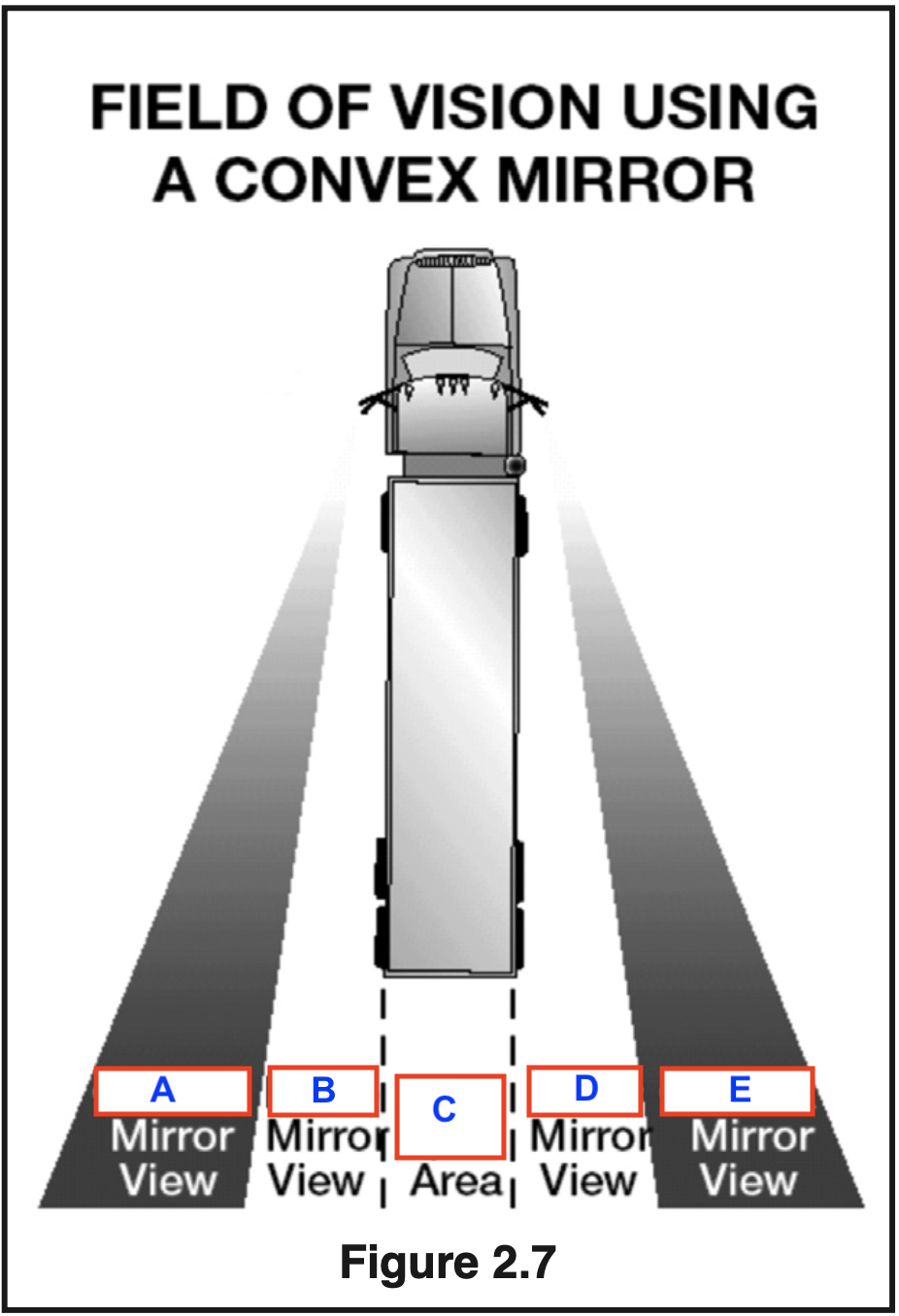
Using the figure above, label each zone:
A B C D E
Your score is sent to your instructor. Tip: both forms of a fraction are accepted (for example, “1/4” or “one-quarter”).